Be yourself; Everyone else is already taken.
— Oscar Wilde.
This is the first post on my new blog. I’m just getting this new blog going, so stay tuned for more. Subscribe below to get notified when I post new updates.
Be yourself; Everyone else is already taken.
— Oscar Wilde.
This is the first post on my new blog. I’m just getting this new blog going, so stay tuned for more. Subscribe below to get notified when I post new updates.
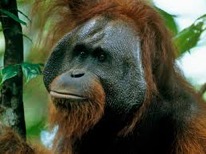
(1)An Image showing the Borneo Orangutan
Borneo orangutans (Pongo pygmaeus) are a critically endangered species (2)and are known as the “man of the forest”. They live among the trees of the rainforest and it is very rare to see them travel across the forest floor, especially the females(3). The welfare of an animal refers to the treatment an individual receives e.g. care and humane treatment. Animal welfare also encompasses the five freedoms which include freedom from hunger and thirst, freedom from discomfort, freedom from pain injury and disease, expression of normal behaviour and freedom from fear (4).
Deforestation
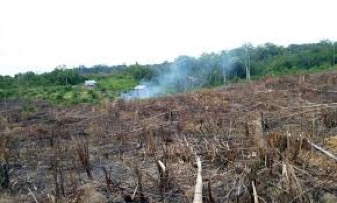
(5) An image showing the impact that is caused by the deforestation for palm oil
One human activity causing a negative welfare impact is the deforestation for the harvest of palm oil in Indonesia (6). Why? Well it takes away the orangutan’s environment and food supply. It causes habitat fragmentation meaning the species have a reduced chance of successful breeding, reducing the overall natural behaviour. When trees are cut down, the orangutan cannot gain access to the fruit to provide it with the nutrients needed therefore it’s not receiving the optimal nutrients (7). Cutting down these trees also leads to climate change, which is seen as an indirect human action, due to the loss of a carbon store (8). Climate change can have a large impact on the orangutan as a change in rainfall pattern leads to less fruit produce, this is a cause for concern as 1, it takes away the food source and 2, orangutans don’t reproduce when their food is scarce (9).
However, on the positive side, there are human actions in place which are combating the problem of deforestation. Like what? An example would be conservation sites set up by charities such as the WWF (3). This shows an example of in-situ conservation as the orangutans are being conserved within their natural habitat. Also, WWF are trying to minimise the harvest of palm, by creating more sustainable commodities which increases the welfare of the Borneo orangutan by ensuring it has a safe environment to nest in and an area where it is guaranteed its usual diet (10). No go reserves have also been set up in countries such as Malaysia which prevent logging and are monitored by rangers(11)further protecting these habitats.
Zoos
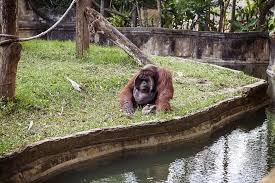
(12) Orangutans that are housed in a zoo
The human action of zoos can be seen as having a negative impact on the welfare of orangutan, with 228 housed across North America(13). This is because the individual is no longer living in its natural environment, and its being confined to a much smaller space. Consequently, they are no longer free to apply their natural instincts present in the wild, leading to an increase in aggression within the animals and showing atypical behaviours e.g. abnormal repetitive behaviour (14). Even though welfare standards require zoos to have a certain amount of space, this is still obviously smaller than the wild. The transfer of animals between zoological collections can also impact welfare due to causing large amounts of stress throughout the process (15).
However, moving onto the positives, by breeding these orangutans in captivity, it provides a safe environment protecting them from deforestation and the pet trade, as well as injury, disease and competition for resources (16). This may eventually lead them to a release programme. There have been many success stories of orangutans being born in captivity, e.g. Monkey world with baby Awan (17), where these individuals are provided with enrichment. As well as this, these zoos are monitored by organisations such as the British and Irish Association of Zoos and Aquariums, so the welfare methods can be regulated ensuring the animal can still live comfortably in a smaller environment (18). They also aim to educate the public, highlighting how you can play a role in helping to increase the welfare of this species (19).
Pet Trade
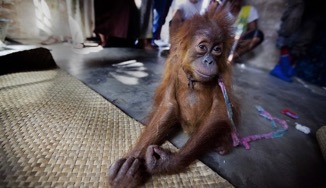
(20) This shows a baby orangutan that has been caught up in the Pet trade
The pet trade also decreases welfare as the children are often taken away from their mother which means both mum and baby would no longer be able to exhibit natural behaviours. The babies easily learn to do tricks and are intelligent animals (21), however people quickly change their mind when the baby orangutan grows up. They become destructive and are swiftly taken out of the home (22). They can then not be rehabilitated as they had not grown up with natural instincts (23). One prime example is due to a popular TV programme in Taiwan where the family had a pet orangutan resulting in 2000 babies being exported and 6000 mothers being killed (22).
On the flip side, following this illegal trade there was positive human action of soft release. This meant the orangutans that were rescued were exposed to rainforest conditions while still being fed, to slowly adapt them into their natural environment (24). The food is eventually phased out until they no longer rely on the rangers. As orangutans are a very intelligent species this is seen as quite an effective method. However, it is also a very intensive and expensive method of trying to conserve (25).
Hunting
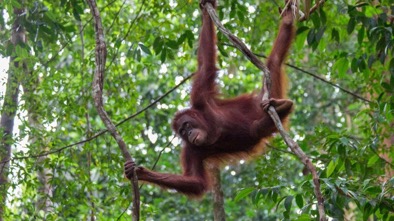
(26) Orangutan seen in a no-go reserve
Hunting is another human activity having a negative effect on orangutan welfare (27). This practice Is carried out for many reasons including farmers killing the animals if they are a threat to their crops. Why? If the orangutan eats the crops, it reduces the overall yield of produce available to the local population decreasing quality of life (28). A similar situation would be when the orangutans are illegally killed if they enter a palm oil plant and risk the yield of young oil palms. Orangutans are also killed for food or if they were seen to be a threat to civilisation (29). This increases suffering and injury throughout the species, creating very negative welfare.
The positive action of no-go reserves is also used to prevent hunting, as rangers are able to limit the exposure of the individuals, preventing poachers coming near the species (22). Also, anti-poacher units are used to prevent the threat of hunting. This is a positive effect on the welfare of the orangutan as 25 rangers are taking up position in the Sabah forests (30). This results in the orangutan being able to live within their natural habitats and show natural instincts such as finding and retrieving their own food leading to an increase in welfare.
Overall, it is difficult to come to a clear conclusion as to whether humans have benefited the orangutan or made it worse, as they have clearly helped through both in-situ and ex-situ conservation, but the question still exits. Would this intervention be needed if the human actions of deforestation and pet trade weren’t there to begin with? You can help by supporting these organisations above, helping to increase the global numbers of the ‘man of the forest’.
References:
This is an example post, originally published as part of Blogging University. Enroll in one of our ten programs, and start your blog right.
You’re going to publish a post today. Don’t worry about how your blog looks. Don’t worry if you haven’t given it a name yet, or you’re feeling overwhelmed. Just click the “New Post” button, and tell us why you’re here.
Why do this?
The post can be short or long, a personal intro to your life or a bloggy mission statement, a manifesto for the future or a simple outline of your the types of things you hope to publish.
To help you get started, here are a few questions:
You’re not locked into any of this; one of the wonderful things about blogs is how they constantly evolve as we learn, grow, and interact with one another — but it’s good to know where and why you started, and articulating your goals may just give you a few other post ideas.
Can’t think how to get started? Just write the first thing that pops into your head. Anne Lamott, author of a book on writing we love, says that you need to give yourself permission to write a “crappy first draft”. Anne makes a great point — just start writing, and worry about editing it later.
When you’re ready to publish, give your post three to five tags that describe your blog’s focus — writing, photography, fiction, parenting, food, cars, movies, sports, whatever. These tags will help others who care about your topics find you in the Reader. Make sure one of the tags is “zerotohero,” so other new bloggers can find you, too.

 Orangutan Welfare